Delete App, Buy Notebook: The Young People Quietly Logging Off and What They're Finding Instead

Photo: Larry D. Moore, CC BY 4.0, via Wikimedia Commons
Somewhere in Brooklyn, a 22-year-old graphic design student named Maya keeps a stack of handwritten letters from people she's never met in person. She found them through a zine she made — photocopied, hand-stapled, distributed at a local record shop — and the correspondence that followed has become, by her own account, the most meaningful creative community she's ever been part of.
Maya doesn't have Instagram. She has an email address and a landline.
This is either the beginning of something real, or the most elaborate aesthetic flex in recent memory. Possibly both.
The Digital Native Who's Over It
Gen Z was supposed to be the generation that cracked digital living. They didn't need to learn the internet — they were born inside it. TikTok, Discord, Substack, BeReal: these were their native languages, their natural habitats. The conventional wisdom said these kids would push digital culture further, faster, deeper.
The conventional wisdom is having a complicated year.
Across the US, a counterculture is building — quietly, almost by definition — among young people who are deliberately choosing analog alternatives to digital-first tools. Email over Slack. Physical journals over Notion. Zines over newsletters. House shows over livestreams. It's not universal, and it's not monolithic. But it's real enough to notice, and interesting enough to sit with.
The question isn't whether it's happening. The question is what it actually means.
What They're Walking Away From
To understand the retreat, you have to understand what's being retreated from. And the honest answer is: a lot.
For a generation that came of age watching engagement metrics define worth, that grew up understanding that attention is currency and virality is validation, the psychological weight of digital-first living isn't abstract. It's daily. It's constant. It's the low-grade hum of always being measurable.
A post either performs or it doesn't. A Discord message either gets a reaction or it disappears into the scroll. Even the most casual digital interaction carries a faint audit trail — who saw it, who responded, who didn't. That's a lot of ambient data to carry around.
Physical media doesn't work that way. A zine doesn't tell you how many people read it. A handwritten letter doesn't have a read receipt. A conversation over coffee doesn't generate analytics. For people who've spent their entire conscious lives inside quantified social spaces, that absence of measurement isn't just appealing — it's genuinely radical.
The Zine Is Back, and It's Personal
The zine revival deserves its own paragraph because it's the most visible artifact of this shift. Walk through any independent bookstore, record shop, or art fair in a major US city right now and you'll find them — small, often chaotic, deeply personal publications covering everything from queer theory to sourdough recipes to local history to grief.
This isn't the zine scene of the '90s riot grrrl movement, though that lineage is acknowledged and honored. This is something slightly different: young people using physical publishing not as a political statement (though sometimes that too) but as a deliberate choice to communicate outside of platforms. To say something without optimizing it. To make something that exists in the world without needing an algorithm's permission to be discovered.
The tactile quality matters here. People talk about the weight of a physical object in a way that sounds almost embarrassingly earnest until you realize they're describing something real: the difference between content and artifact. A zine is a thing. It takes up space. You can fold it, annotate it, leave it on a friend's doorstep. You can't do that with a Substack post.
Face-to-Face as Countercultural Act
Maybe the most striking part of this analog rebellion is the renewed investment in in-person gathering — particularly among young people who theoretically have every tool to connect remotely.
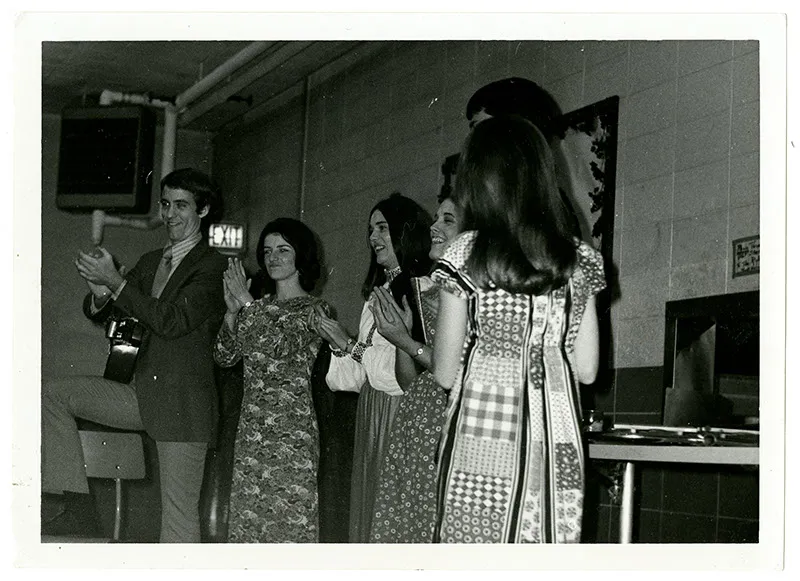
House shows are back in a big way in cities like Chicago, Austin, Philadelphia, and LA. Small reading groups are forming around physical books. Board game nights are being organized via — and this is not a joke — printed flyers. The deliberate friction of in-person coordination, the inconvenience of showing up somewhere at a specific time, is being reclaimed as a feature rather than a bug.
This is, in its own way, a form of signal-breaking. The digital infrastructure is there. It's being ignored on purpose.
Vintage Costume or Genuine Shift?
Here's where it gets complicated, and where intellectual honesty requires some friction.
A lot of what's being called the analog rebellion is also, undeniably, an aesthetic. The risograph-printed zine is a beautiful object. The handwritten letter has a cinematic quality. The cassette tape — yes, people are releasing music on cassette again — looks incredible on a shelf. There's a real question about whether some of this is rejection or just the next evolution of digital culture wearing a vintage costume.
After all, the zines get photographed and posted. The house show gets documented on someone's story. The handwritten letter often gets scanned and shared. The analog artifact and the digital platform aren't always as separate as the rhetoric suggests.
But maybe that's okay. Maybe the binary — fully online versus fully off — is a false choice, and the more interesting question is about intentionality. Are you choosing your tools, or are your tools choosing you? Are you posting because you want to, or because the platform has made it the path of least resistance?
For the young people leading this shift, the answer seems to be: we want to choose. We want the friction. We want the weight of the physical thing, the inconvenience of the in-person meeting, the slowness of the handwritten word — not because we're rejecting technology, but because we're rejecting the assumption that digital-first is always better.
What the Rebellion Is Actually Saying
The analog counterculture among Gen Z is less about nostalgia than it is about negotiation. These aren't people who want to live in 1995. They're people who grew up inside systems designed to capture their attention, and they're starting to ask whether those systems were built for their benefit or someone else's.
The zine, the letter, the face-to-face hang — these aren't solutions to the problems of digital life. They're experiments. Small, personal, sometimes beautiful experiments in what communication feels like when nobody's optimizing it.
At Loyeyvk, we find that interesting. The signal breaks, and something shows up in the static. Maybe that's what these kids are actually chasing.